

From Cologne to India: Gerald Böse on Koelnmesse’s Growth Strategies and Emerging Opportunities in Asia
In an exclusive conversation with TradeFairTimes, Gerald Böse, President and CEO of Koelnmesse GmbH, shares his perspective on the company’s evolution, the challenges faced by the global exhibition industry, and the strategies that have kept Koelnmesse at the forefront. This interview offers valuable insights into how a global exhibition leader navigates change while exploring new markets.

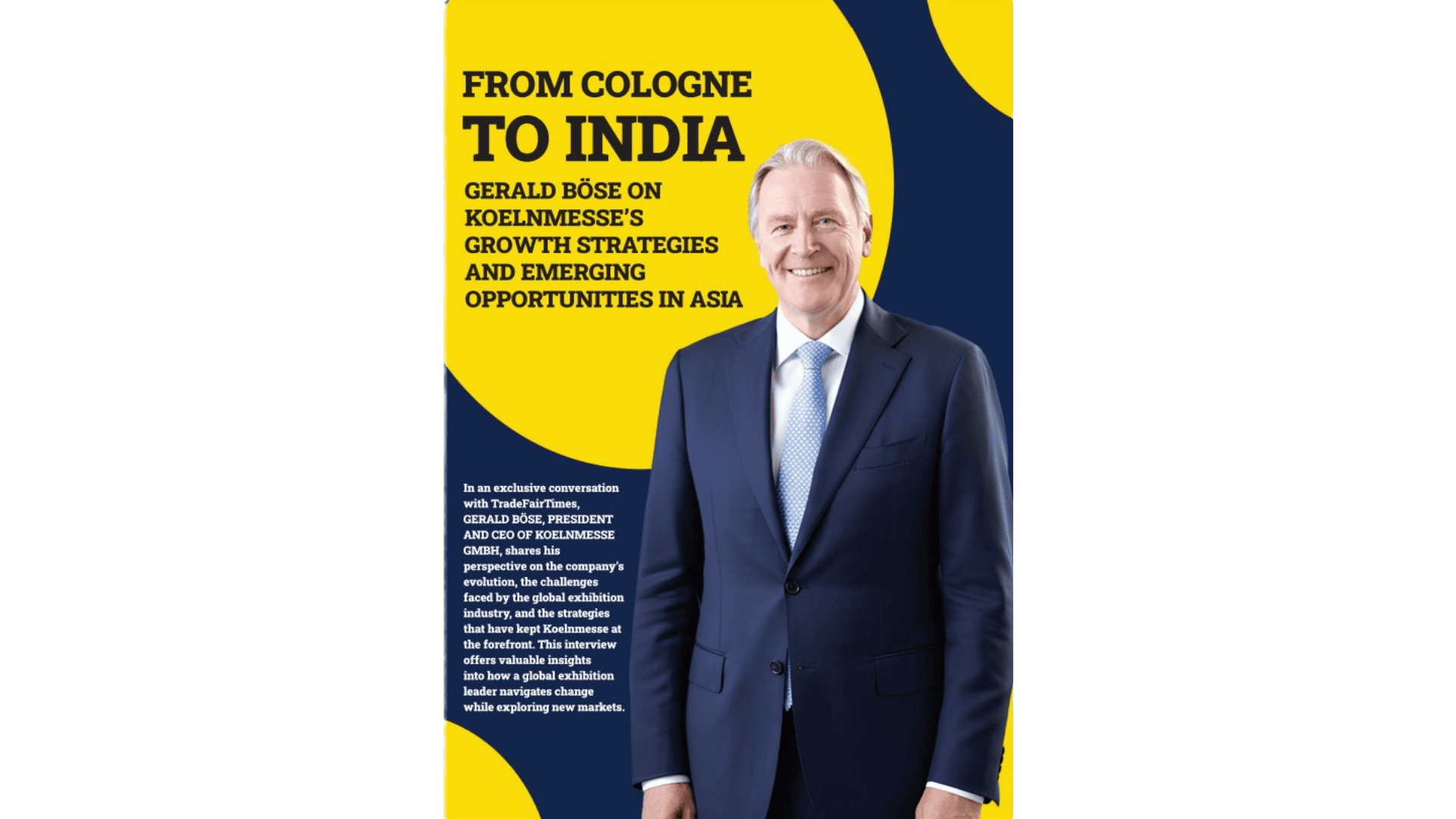
TFT: Koelnmesse GmbH is Germany’s largest trade fair organizer and venue provider. Please tell us more about the company, its inception, growth, trade fairs organised and other services.
Gerald Böse: Koelnmesse has quite the pedigree — founded in 1924 by Konrad Adenauer, who would later become the first Chancellor of modern Germany. The idea back then was to create a peaceful trading hub in the wake of the First World War. That vision of international cooperation and peaceful exchange across borders still defines us today — now perhaps more than ever.
Over the past century, we’ve grown into one of the world’s top ten trade fair companies — operating Germany’s third-largest fairgrounds and welcoming 2.1 million visitors and 34,500 exhibitors in 2024 alone. That’s across more than 80 trade fairs annually, covering industries from gaming to food, furniture to digital technology. We don’t just mirror these industries — we help shape them.
TFT: As Koelnmesse celebrates its 100th anniversary, what were the major challenges faced and how do you envision the company’s evolution over the next decade, especially in the context of global trade dynamics?
Gerald Böse: The greatest challenge in recent memory — and arguably beyond — was the COVID-19 pandemic. It shook the entire industry, both financially and existentially. Events were cancelled. Travel ground to a halt. But we used that crisis as a catalyst to reinvent ourselves. We launched a digital division, accelerated our sustainability efforts, and redefined what a trade fair company could be. And the results speak for themselves: by 2023, we had bounced back and already surpassed our pre-pandemic performance. Since then, we’ve launched more than 20 new international events.
Looking ahead, our vision for 2035 is bold: we aim to be among the world’s top five trade fair companies with their own venue. That means deeper international expansion, smarter service growth, and an unwavering focus on sustainability and customer value. But no matter how tech-driven we become, one thing will never change — our purpose is to bring people together, in person, around the world.
TFT: Koelnmesse aims to be climate-neutral by 2030. Could you elaborate on the key initiatives and milestones set to achieve this ambitious target?
Gerald Böse: As an industry, it is imperative that we reduce our climate footprint — and energy is an obvious lever. That’s why we are committed to achieving climate neutrality in our energy use by 2030. In 2022, we switched to 100% renewable electricity. We’ve installed Cologne’s largest inner-city solar plant on our rooftops, generating 3 million kWh annually. In addition, we are currently transitioning to a geothermal heating system, enabling us to stop burning natural gas entirely by 2028. We’re also forging ahead with electric vehicle charging stations — some quite literally on top of our halls — and investing in energy-efficient lighting and ventilation across the site.
But it’s not just about infrastructure. Our award-winning logistics management system, eSlot, helps reduce lorry emissions. Our stand construction is shifting towards circular and bio-based materials. And smarter waste systems are becoming the norm. We are moving forward on all fronts.
TFT: With a presence in over 100 countries, what strategies are in place to further strengthen Koelnmesse’s global footprint, particularly in emerging markets?
Gerald Böse: Expanding into new growth markets and globalising our brands has long been our strategy — and it’s paying off. In Southeast Asia and Latin America, we’re seeing record growth, with events like gamescom latam in Brazil attracting over 135,000 visitors this year. But one of the most strategically dynamic markets right now is India. As global supply chains shift and reshoring in some industries gains momentum, India is rapidly emerging as a key production and innovation hub. That’s why we’re significantly expanding our activities there.
And our strategy is not just to export brands, but to localise them. Just as with THAIFEX – Anuga Asia in Bangkok — which has evolved into the leading food and beverage trade fair in Asia — our platforms in India are tailored to regional industries, business culture and economic momentum. This approach of combining global reach with local relevance is what makes Koelnmesse a truly international powerhouse.
TFT: Please tell us how Koelnmesse’s exhibition spaces can be beneficial to organisers worldwide.
Gerald Böse: First: location. We’re in the heart of Cologne — just a stone’s throw from the cathedral, hotels, and the bustling city centre. Cologne boasts not only a vibrant cultural life and start-up scene, but also serves as an industrial and logistical hub. With five major airports nearby and direct high-speed rail connections from European capitals like Paris, Amsterdam, and Brussels, international access is seamless.
Second: scale and flexibility. We offer a total of 400,000 m² of space, including nearly 300,000 m² of hall and conference capacity. This includes our new Confex — purpose-built for hybrid, large-scale international conventions and congresses, accommodating over 6,000 participants.
Third — and this matters — we’re built for the next generation of events: digital visitor journeys, modular spaces, ESG-compliant infrastructure, and real-time matchmaking technology. Whether you’re a global organiser or a local innovator, Koelnmesse offers the perfect ecosystem.
TFT: Considering India’s burgeoning economy, what initiatives are underway to deepen Koelnmesse’s engagement with Indian businesses and stakeholders?
Gerald Böse: India is a strategic priority for Koelnmesse. We see immense potential — not just in staging events, but in building long-term partnerships that reflect the country’s accelerating role in global trade and production. That’s why we’ve established a dedicated Task Force India at our headquarters, where we’re working closely with our local team in Mumbai to define priorities and drive forward concrete initiatives. We’ve just successfully brought the INTERNATIONAL HARDWARE FAIR INDIA to market, announced the launch of ORGATEC India, and introduced Anuga FoodTec India Dairy for 2026. And this is only the beginning. So stay tuned for what’s next!
TFT: Koelnmesse Pvt. Ltd. was established in 2008 in India. As per your observations, what are the challenges faced by the company in the Indian market and how the company adapted to it?
Gerald Böse: When Koelnmesse Pvt. Ltd. was established in 2008, one of the key challenges was entering a highly competitive landscape dominated by strong local organisers. Building trust, brand visibility, and a distinctive profile took time and persistence. But through consistent delivery, international standards, and close engagement with Indian industries, we gradually earned recognition — especially in sectors like food technology, where we’ve seen particularly strong and sustainable growth.
Today, Koelnmesse is regarded as a reliable, high-quality partner — not just for organising leading trade fairs in India, but also for supporting Indian companies in expanding their global reach through our events in Cologne and across the world. That dual role — local anchor and international bridge — is what defines our value in the Indian market today.
TFT: At last, what message would you like to give to our readers?
Gerald Böse: The past century has taught us that the key to resilience is adaptability. Whether we’re facing global conflict, navigating digital disruption, or advancing sustainability, it is our creativity that propels us forward.
Trade fairs — at their heart — are about innovation and human connection. No screen, no algorithm can replicate that moment when people meet, shake hands, and spark ideas. That’s what Koelnmesse is all about — and that is the magic we strive to preserve, enhance, and share with the world.