

From Budget Constraints to Time Poverty: How the Economics of Events Have Quietly Changed

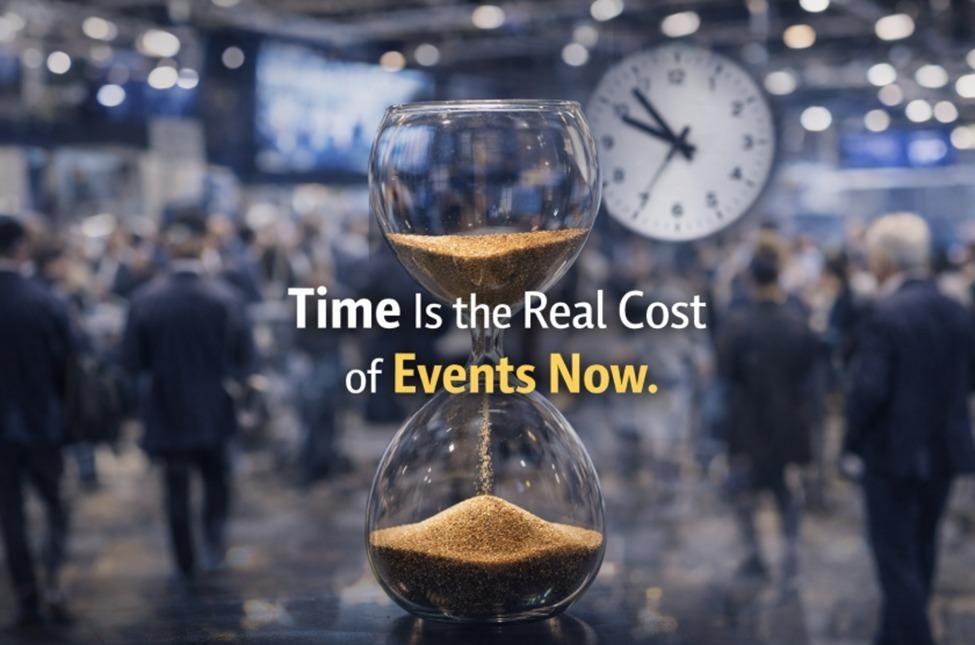
For years, the events industry convinced itself that money was the biggest barrier. Ticket prices, booth costs, travel budgets, everything revolved around spending. That problem is largely solved. Companies still pay. Sponsors still show up. Buyers still travel. What’s actually scarce now isn’t money. It’s time.
Executives, founders, and senior buyers are not breaking; they’re exhausted. Their calendars are packed, their attention is fragmented, and their tolerance for inefficiency is close to zero. Asking them to spend three or four or five full days walking halls and hoping value “reveals itself” is no longer realistic. That model belongs to a time when decision-makers had slack. Today, they don’t. Yet most events are still designed as if time is unlimited. Long show durations, sprawling floor plans, and unstructured discovery are treated as features rather than liabilities. The assumption is that more space creates more opportunity, more days create more ROI, and more randomness leads to better connections. In reality, this creates friction. Walking halls without intent isn’t networking; it’s wasted energy disguised as engagement.
Time-poor attendees behave differently. They don’t want experiences for the sake of experiences. They want outcomes. They want to know who they’re meeting, why that meeting matters, and what comes out of it. They prefer pre-qualified conversations over accidental encounters, high signal over high volume, and control over their schedules instead of being forced into wandering. If an event can’t justify the value of each hour, it quietly loses relevance. This is where the next phase of growth will come from, not bigger shows, but tighter ones. Events that compress value into shorter formats will win. One-day or one-and-a-half-day shows will outperform four-day marathons. High-density networking with fewer but more relevant participants will matter more than footfall numbers. Appointment-driven formats will take priority over passive booth browsing. Agendas will increasingly be designed around roles, because buyers, exhibitors, and founders don’t come for the same reasons, and pretending they do is lazy design.
Here’s the uncomfortable test that most events fail. Can an attendee walk away with 80 percent of the value in under a day? Do buyers know exactly who they’ll meet before they arrive? Is walking the floor optional, or is it the only way to extract value? And are outcomes measured in anything more meaningful than headcount and badge scans? If the answer to most of these is no, the event isn’t creating value; it’s consuming time. Time poverty doesn’t kill events. Ignoring it does. The future doesn’t belong to the biggest shows with the loudest marketing. It belongs to the most precise ones. The events that respect time as the most expensive resource in the room will earn attention, loyalty, and repeat participation. The rest will slowly become background noise.
Design for time accordingly, because now, it’s the real budget.