


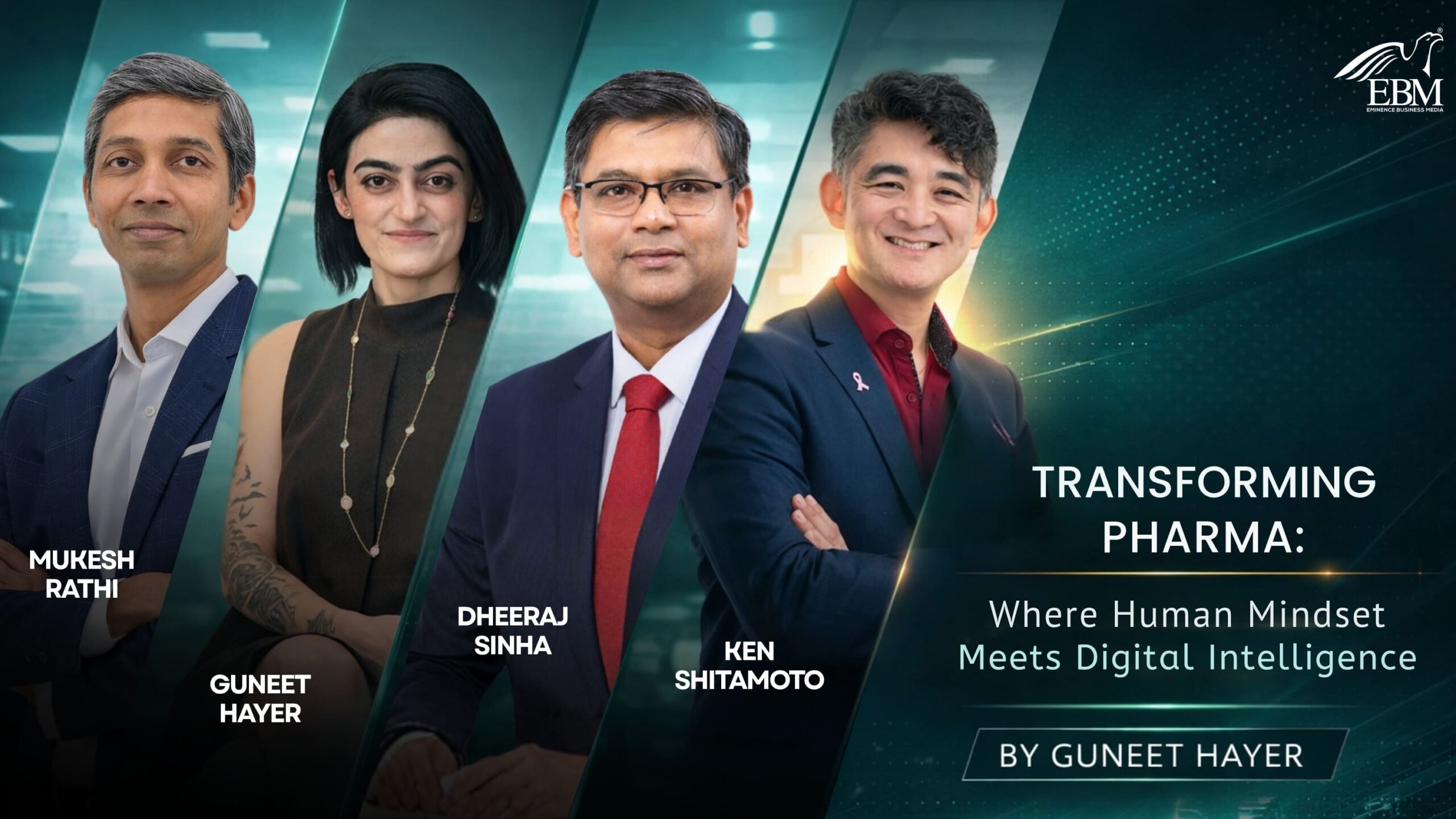
Let me start with a line that might sting a little (but in a friendly way)- Pharma doesn’t have a technology problem. It has a translation problem.
We have technology. Plenty of it. We have automation, MES, LIMS, ERP, eQMS, dashboards that look like they belong in a spaceship, and AI pilots that get presented more often than they get scaled. Yet, when you walk into many plants and offices, you still see the same old choreography: long SOPs, longer approvals, and decisions that travel from one inbox to another like they’re on a spiritual journey.
So, what’s missing?
After interviewing Dheeraj Sinha, Mukesh Rathi, and Ken Shitamoto, and after doing my own pattern-spotting across conferences, quality discussions, and industry conversations, I have arrived at a simple conclusion:
Digital transformation in pharma is not an IT project. It is a behavior change program wearing a technology badge.
And if we treat it like “just a system implementation,” we will keep getting what we already get- adoption theatre. What it struggles with, far more consistently, is people, mindset, and the courage to rethink how work actually gets done.
Mindset Before Machines (Yes, Again- Because It Still Matters)
Most pharma organizations begin transformation by asking: Which tool should we buy? Yet the better question is- Which habit should we break? Dheeraj said something that nails the difference between digitization and transformation, “Digital change doesn’t happen because you buy a platform. It happens when your people understand why they need it, and how they can use it to make better decisions.”
Transforming Pharma
That “why” is the entire game. Because if the organization doesn’t emotionally and operationally believe in the new way of working, the tool becomes what Dheeraj described as a decorative layer over old habits. Mukesh took it further by naming the real barriers. In his view, technology isn’t the primary blocker, the bigger barriers are leadership mindset, regulatory overhang, and capability, “Irrespective of any industry, I don’t think technology is ever a barrier… the most important is mindset, primarily leadership mindset… the second is regulatory overhang… and third… right capability.”
Ken was even more direct (and honestly, I laughed because of how universally true it felt), “People are the bigger problem… resistance and unwillingness to learn something new.”
Here’s my synthesis, the real transformation equation is:
Digital Transformation = Behavioral change + Process redesign + Data discipline + Technology
And what most companies try- Technology First. But in pharma, that’s like buying a Ferrari and then discovering your road is still full of potholes. The car isn’t the issue, probably the drive from Kedarnath to Badrinath is.
The Three Traps Pharma Keeps Falling Into (and how to climb out)
Trap 1: “Automation = Transformation”
Automation is speed. Transformation is direction.
Mukesh acknowledged something I see repeatedly- companies automate processes that were never fixed in the first place. So, you don’t improve performance, you accelerate dysfunction, “Processes were designed for manual ways of working… unless you rethink them… you end up solving the wrong problem.”
Trap 2: “Training = Capability”
Training is a session. Capability is a system. Mukesh reframed this beautifully, “I would call it capability building… at three different buckets… senior management… execution people… and the digital team itself.”
Trap 3: “Compliance means complexity”
Compliance should mean control and clarity, not bureaucracy as a lifestyle choice.
Ken challenged pharma’s habit of treating itself as uniquely special, “The biggest misconception is that we think we are special… we create barriers because we think we’re different.”
When we combine these traps, we get a predictable outcome:
- Heavy SOPs
- Slow decisions
- Digital tools nobody loves
- And teams that say “AI is coming” every year (How they kept saying “Winter is Coming” for 6 seasons of Game of Thrones.
AI in Pharma Sales and Pharmacovigilance. (Where Theory Finally Meets the Field)
Let’s segregate clearly, sales AI is not the same conversation as PV AI. Sales is about performance and precision. PV is about safety and signal detection. Same tools, different ethics, different governance. Dheeraj described the power of AI in commercial execution, “AI today can analyze thousands of signals and tell your rep what to do tomorrow morning… it is revenue impact.”
Mukesh grounded this in a very real, very Indian field reality, “A typical medical representative… gets about 1 to 2 minutes with a doctor… the first two to three brands mentioned… AI can do wonders there.”
Here’s my author brain thinking from these inputs on why sales AI often succeeds earlier than quality AI because sales have:
- Fast feedback loops (weekly/monthly outcomes)
- Clear KPIs (prescription lift, coverage, conversion)
- Leadership attention (because revenue has a loud voice)
Sales AI becomes a “proof of value” engine. But we must not make the mistake of thinking success in sales automatically means we can copy-paste AI into every other function. Different departments are different planets.
Ken reminded us that AI’s sweet spot is pattern recognition but warned about misunderstanding AI at senior levels. And I’ll add that misunderstanding AI isn’t just a knowledge gap; it’s a governance risk.
Now we switch lanes from revenue to responsibility. Dheeraj pointed out a deep systemic issue in India’s PV culture, “Manufacturers must update every drug with new adverse reactions regularly. But we don’t have enough real-world reporting coming from the field. We rely heavily on journals instead of live data.”
And this is where my own thinking gets sharp, PV has a “data reality” problem, not an “AI imagination” problem. We often talk about AI like magic. In PV, AI is only as good as:
- Reporting discipline
- Case quality
- Structured data capture
The opportunity is massive: AI can scan literature, detect weak signals, and connect dots across geographies. But PV needs governance so strong that it can survive audits, scrutiny, and ethical questioning. In PV, “oops” is not an acceptable outcome. Mukesh observed, “Quality and PV get attention because fear is involved. Fear is a stronger emotion than opportunity.” And yet emphasized that fear is important too because fear is a strong motivator. But fear shouldn’t be the only strategy. Safety deserves proactivity, not panic.
Regulatory Timelines: When Scale Finally Breaks Manual Work
Dheeraj highlighted the brute-force reality of regulatory scale, “To research and qualify over 2,000 drugs every year is not humanly scalable without data automation.” This isn’t about replacing humans. It’s about relocating human effort from- repeated checks, manual reconciliation, document chasing to risk-based decisions, scientific judgement, and trend interpretation
My take on this: The future regulatory model is “human-in-the-loop,” not “human-as-the-loop”. And think about it, if humans are the loop, everything bottlenecks. If humans are in the loop, the system scales while preserving accountability.
SOPs: Or How We Accidentally Made Simple Things Very Complicated
Now let’s talk about my favorite subject and repeatedly discussed topic in all conferences I have designed and hosted with a dedicated never-ending Q&A: Mother of all Problems- SOPs. It indeed is the silent killer of speed. Would automation help here? Dheeraj’s statement is a headline by itself, and giving a clear picture “If the process itself is broken, digitizing it will only make the broken process run faster.” His point is not anti-digital. It is anti-blind-digitalization. When organizations take an already bloated SOP and convert it into a workflow system without redesigning it, they don’t gain efficiency, they institutionalize complexity.
Let’s look at fixing the problem before automating it and producing non-sensical results at 10X speed. Most SOPs did not become complex overnight. They became complex incrementally, decision by decision, audit by audit, observation by observation. Each time a regulator raised a concern, organizations responded rationally: add a control, add a reviewer, add a step. The intention was always right, prevent recurrence, ensure compliance, reduce risk.
The problem is that very few organizations ever go back to subtract.
Change control, in principle, is a sensible mechanism: evaluate risk, get approvals, implement safely. But over years of regulatory feedback, many pharma companies have turned it into an endurance test.
Mukesh described organizations where a simple change control passes through ten levels of approval, often taking weeks just to be approved, before any change is implemented, “What was probably a simple process earlier has become three times more complex… because every time there was an observation, more guardrails were added. Nobody goes back to re-evaluate because of fear. Fear of changing something once the regulator asked for it.”
What Mukesh is pointing to is not regulatory pressure alone, but how organizations internalize that pressure. Instead of applying judgment, they apply accumulation. Instead of risk-based thinking, they default to rule-based expansion.
Ken Shitamoto’s perspective comes from observing this pattern globally across industries, not just pharma. He re-validated Mukesh’s thoughts by adding that when organisations design SOPs assuming people will always make mistakes, they compensate with layers of approval. When they design SOPs assuming people can be trained to think, they focus on clarity, intent, and accountability. Putting all three perspectives together, the issue is not SOPs themselves, it is SOPs that have outlived their purpose.
Here’s what I want leaders to hear (in my voice):
- Redesigning SOPs before digitizing them
- Simplifying workflows using risk-based logic
- Making procedures readable, usable, and meaningful for the people who execute them.
Your SOP is not a museum. It’s a tool. Tools are meant to be used, not worshipped. Ken’s point about unnecessary bureaucracy being driven by distrust is relevant here too. Sometimes we add signatures to feel safe, but safety comes from clarity, not paperwork.
Capability Building, Not Just Training
“I wouldn’t call it training. I would call it capability building.”, said Mukesh Rathi when I asked him about transforming training methods and talent developments in pharma organizations. If you want a transformation strategy that doesn’t expire in 12 months, build capability. Mukesh’s “three-layer capability building” is a strong model.
Leadership → Translators → Digital Team
Ken adds another practical layer: don’t just teach guardrails; teach value use-cases, otherwise you invite chaos. “Telling people what not to do with AI isn’t enough. You must also show them what they can do.”, Ken Shitamoto
My synthesis:
- Build three roles inside the organization
- Digital Sponsors (leaders who fund outcomes, not tools)
- Business Translators (people who understand process + data + tech)
- Digital Builders (AI/engineering teams who can execute responsibly)
Without these roles, the organization becomes dependent on vendors for thinking, and that is the fastest way to lose maturity.
Looking Ahead
The most honest closing line still belongs to Dheeraj, “Technology is finally ready. The question now is, are we ready to work differently?”
Ken warned leaders not to become dinosaurs by refusing to learn. He emphasized on maintaining the learning mindset, “AI is a universal reset. Everyone is starting at zero again.”
Mukesh emphasized foundations: infrastructure, capability, and business embedding. And I’ll end with my own author’s punchline: In pharma, digital transformation isn’t blocked by algorithms. It’s blocked by “We have always done it this way. And that, unfortunately, is the most stubborn software in the world.
Let’s conclude with a quick summarization of the understanding from the interview of these brilliant experts. If there is one lesson, it’s this: pharma doesn’t need another system rollout, another pilot, or another three-letter acronym. It needs fewer PowerPoint slides and more uncomfortable conversations.
Digital transformation will not fail because AI isn’t powerful enough. It will fail because we tried to automate habits we never questioned, SOPs we never simplified, and mindsets we never upgraded.
Technology, as it turns out, is ready.The data is (almost) ready. The vendors are definitely ready.
The only question left is whether we are willing to uninstall “we’ve always done it this way”, because no amount of AI can debug that code.