


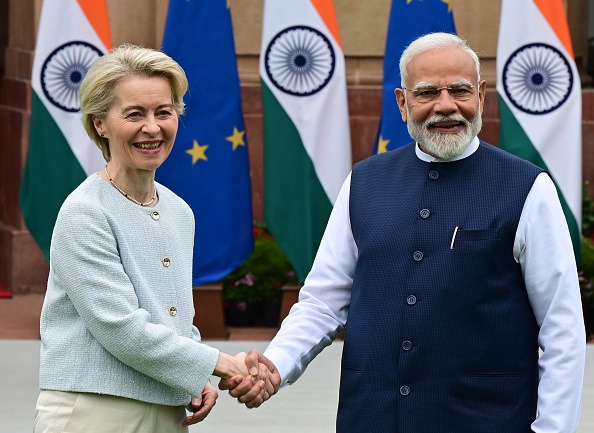
India and the European Union (EU) have finalised a historic Free Trade Agreement (FTA) after nearly two decades of negotiations – a pact widely described as the “mother of all trade deals.” The agreement was announced at the India-EU Summit in New Delhi by Indian Prime Minister Narendra Modi and senior EU leaders, with the aim of creating a free-trade zone covering around 2 billion people and nearly 25% of global GDP.
“This agreement will deepen the economic ties, create new opportunities for our people, and strengthen the partnership between India and Europe for a future characterized by prosperity,” said Indian Prime Minister Narendra Modi.
The EU and India already trade €180 billion worth of goods and services every year. Moreover, with roughly 6,000 European companies operating in India, the trading relations supports nearly 800,000 European jobs.
What are the important aspects of the deal?
- Under the deal, India will eliminate or reduce tariffs on 96.6% of EU exports by value. Meanwhile, the EU will reciprocate by reducing tariffs on 5% of Indian goods. The European Commission projects $4.7 billion in annual duty savings, with exports potentially doubling by 2032.
- European carmakers are set to benefit from this deal as the previous tariffs on European cars by India stood at 110% which after the deal will be just 10%. This will increase competition in the Indian auto market providing a wide range of varieties for the consumers to choose and thereby increasing the number of participants in the Indian exhibitions like ACMA, Bharat Mobility Expo and more. It will also facilitate the manufacturing and components companies present in the sector.
- To protect India’s domestic manufacturers, European cars priced below €15,000 (A$25,500) will face higher tariffs, while electric vehicles get a five-year grace period.
- 4% tariff lines covering 90.7% of India’s exports will have immediate duty elimination for important labour-intensive sectors such as textiles, leather and footwear, tea, coffee, spices, sports goods, toys, gems and jewellery and certain marine products.
- The EU has granted immediate zero-duty access for India’s labor-intensive exports including textiles, apparel, leather, footwear, gems and jewellery.
- 3% tariff lines covering 2.9% of India’s exports will have zero duty access over 3 and 5 years for certain marine products, processed food items, arms and ammunition, amongst others;
- The services dimension may prove transformative, too. The EU committed to opening 144 subsectors particularly IT, professional services and education and facilitate easier labour mobility.
- Wine is particularly notable – tariffs are being slashed from 150% to between 20–30% for medium and premium varieties. Spirits face cuts from 150% to 40%.
Sector Wise Impact:
Facilitating India’s Labour-Intensive Workforce:
The FTA creates a structured and predictable framework for the temporary entry and stay of professionals, covering categories such as Business Visitors, Intra-Corporate Transferees, Contractual Service Suppliers, and Independent Professionals. Through this comprehensive mobility mechanism, India further reinforces its standing as a global talent hub.
The agreement facilitates smoother movement of employees of Indian companies operating in the EU along with their spouses and dependents across all service sectors. Additionally, Indian businesses seeking to deliver services under contractual arrangements with EU clients gain access to 37 sub-sectors, including IT, business, and professional services.
Accelerating Exports through Engineering Excellence:
With preferential market access for engineering goods many of which currently attract tariffs of up to 22% the FTA is set to significantly boost India’s exports to the EU, valued at around INR 1.44 lakh crore (USD 16.6 billion). It is also expected to strengthen India’s share in the EU’s engineering goods import market, estimated at nearly INR 174.3 lakh crore (USD 2 trillion).
The agreement is likely to provide a major impetus to MSME-driven industrial clusters, accelerating industrial modernisation and enhancing global competitiveness.
Agri Sector:
India secures preferential market access for its agricultural exports, boosting competitiveness for processed foods, tea, coffee, spices, table grapes, gherkins and cucumbers, sheep and lamb meat, sweet corn, dried onion, and some other fruits and vegetable products.
Leather and Footwear sector:
The removal of tariffs currently as high as 17% to zero upon the FTA’s entry into force across all tariff lines will create a more competitive environment for India’s exports to the EU, which are presently valued at around INR 20.9 thousand crore (USD 2.4 billion). This move is expected to strengthen India’s position in the EU’s leather and footwear import market, estimated at nearly INR 8.71 lakh crore (USD 100 billion).
Further, regulatory harmonisation, streamlined compliance procedures, and greater emphasis on design-driven and sustainable products will support the sector’s transition from low-margin manufacturing to higher value-added global competitiveness.
Marine Exports:
Preferential access covering 100% of trade value, by reducing tariffs of up to 26% will unlock the EU marine market for imports (INR 4.67 Lakh Crore (USD 53.6 billion)). This enhanced market access is expected to significantly improve the competitiveness of India’s marine exports, while complementing and strengthening India’s export capacity in the marine sector, currently valued at INR 8,715 Crore (USD 1 billion) to the EU. The FTA will turbo-charge exports of shrimp, frozen fish, and value-added seafood exports, empowering coastal communities in Andhra Pradesh, Gujarat, Kerala, and beyond and India’s blue economy
India’s Medical Instruments, Appliances, and vital Supplies:
India’s medical instruments, appliances, and essential healthcare supplies sector — driven by advanced manufacturing capabilities, innovation, and a skilled workforce — is poised for significant expansion in the EU market. With tariffs of up to 6.7% being eliminated across 99.1% of trade lines, Indian products such as lenses, spectacles, medical devices, and measuring and testing instruments will gain more cost-competitive access to European markets.
Textiles and Apparels:
Securing zero-duty access for textiles and clothing across all tariff lines with reductions of up to 12% — would unlock the EU’s import market valued at approximately INR 22.9 lakh crore (USD 263.5 billion).
Building on India’s existing global textile and apparel exports of around INR 3.19 lakh crore (USD 36.7 billion), including nearly INR 62.7 thousand crore (USD 7.2 billion) to the EU, this enhanced access is expected to substantially widen market opportunities. Key beneficiary segments would include yarn and cotton yarn, man-made fibre apparel, ready-made garments, men’s and women’s wear, and home textiles.
Plastic and Rubber:
India’s plastic and rubber industries are set to benefit from preferential access to the EU – a market with global imports valued at nearly INR 27.67 lakh crore (USD 317.5 billion). With India’s exports to the EU currently at around INR 20.9 thousand crore (USD 2.4 billion) and total global exports standing at approximately INR 1.13 lakh crore (USD 13 billion), the agreement presents significant headroom for expansion.
Improved market access under the FTA, coupled with India’s skilled manufacturing base and MSME-led innovation ecosystem, is expected to drive higher employment, expand export volumes, and reinforce the country’s position in global trade.
Chemicals:
FTA ensures zero duty on 97.5% of India’s chemical export basket by value, eliminating duties of up to 12.8% and boosting competitiveness across inorganic, organic, and agrochemicals.
Mines and Minerals:
Zero duty across 100% of tariff lines breaks cost barriers, ensuring India exports quality, reliable, and value-added minerals to the EU.
Home Décor, Wooden Crafts and Furniture:
Lower duties of up to 10.5% provides enhanced access, boosting the competitiveness of Indian wooden, bamboo, and handcrafted furniture. The FTA supports growth in high-value, design oriented segments and strengthens India’s role in global furniture supply chains.
What does it mean to the Indian Exhibition Industry?
The conclusion of the India-European Union (EU) Free Trade Agreement (FTA) in early 2026 is a transformative moment for India’s exhibition industry. Often referred to as the “mother of all trade deals,” it doesn’t just lower tariffs on goods; it fundamentally reshapes the MICE (Meetings, Incentives, Conferences, and Exhibitions) landscape.
Here is how the trade deal will impact the Indian exhibition industry:
- Surge in Sector-Specific B2B Exhibitions
The FTA aims to double bilateral trade by 2030. As tariffs drop to zero on over 99% of Indian exports (like textiles, leather, and gems) and significantly reduce on European imports (machinery, chemicals, and wine), the demand for “market-entry” platforms will skyrocket.
- Textiles & Apparel: Expect a massive expansion of shows like Bharat Tex, as Indian manufacturers look to leverage duty-free access to 450 million European consumers.
- Industrial Machinery: Since India has reduced duties on high-tech European machinery, we will see a rise in specialized industrial expos featuring German and Italian technology.
- Operational Ease: The “Professional Mobility” Boost
One of the most significant wins for the industry is the comprehensive mobility framework.
- Easier Visas: The deal simplifies short-term business visits for Contractual Service Suppliers and Independent Professionals. This means European organizers (like Messe Frankfurt or Informa) can more easily fly in expert teams, technical staff, and speakers.
- Reciprocity: Indian exhibition organizers will find it easier to host “India Pavilions” at major European shows (like Hannover Messe), with clearer rules for staff travel and temporary stays.
- Streamlined Logistics for Exhibits
Historically, moving high-value prototypes and exhibition materials through Indian customs was a bottleneck.
- Expedited Customs: The FTA includes a chapter on Customs and Trade Facilitation, emphasizing paperless trading and expedited release of goods.
- Temporary Admission: While the ATA Carnet system already exists, the FTA reinforces these protocols, making it cheaper and faster for European exhibitors to bring advanced machinery and sensitive equipment into India for display without paying full import duties.
- Inbound Investment in Venue Infrastructure
Europe is the global leader in exhibition management. The “predictable and stable regime” created by the FTA encourages European venue giants to invest directly in India.
- Modernization: Expect increased foreign direct investment (FDI) in Indian venues to bring them up to European sustainability and digital standards (Euro-standard facilities).
- Joint Ventures: We are likely to see more JVs between Indian state governments and European organizers to manage mega-complexes.
- Focus on “Meet in India” Branding
With the FTA in place, the Indian government is doubling down on the “Meet in India” campaign to position the country as a global alternative to China for large-scale conventions.
- Geopolitical Hedging: As European businesses look to diversify supply chains (“China Plus One”), the exhibition floor in India becomes the primary site for forging these new “trusted” partnerships.
Some Limitation Persist:
Though the deal is historic but some complications do persist.
- EU’s Strict laws on Carbon Emission Mechanism: Importantly, the EU’s Carbon Border Adjustment Mechanism (CBAM) remains in place despite India’s objections. However, Brussels has committed $590 million to support India’s decarbonisation efforts, as steel and aluminium exporters are set to face additional carbon-related costs beginning in 2026.
- Ambitious Yet Measured: While ambitious by India’s standards, the agreement has clear boundaries. It deliberately stops short of deeper policy alignment in several key areas. Notably, it does not incorporate comprehensive commitments related to labour rights, environmental safeguards, or binding climate obligations.
- Market Access with Strategic Safeguards: The EU continues to retain tariffs on sensitive agricultural products such as beef, poultry, dairy, rice, and sugar. While consumers in Delhi may benefit from more affordable European automobiles, European farmers remain shielded from external competition.
- Protecting Domestic Interests While Expanding Global Reach: India has strategically protected sensitive sectors such as dairy, cereals, poultry, soymeal, and select fruits and vegetables, ensuring a careful balance between export expansion and domestic priorities. At the same time, the FTA creates avenues for Indian agriculture to secure higher value in European markets, stimulate sectoral growth, and strengthen long-term resilience through stable livelihoods and sustainable income opportunities.
The trade deal goes back to 2007 when it was first initiated then the talks were stalled in 2013. India- EU declared this deal in the early 2026 making it a two decade long negotiations. The deal is looked upon as ambitious which will facilitate the growing needs of India and the EU and It comes at a time when there is global uncertainty. As the ‘mother of all trade deals’ moves from ink to implementation, it doesn’t just open a free market for two billion people; it marks the dawn of a new era where the world’s two largest democracies serve as the dual engines of global stability and prosperity.