

𝐍𝐚𝐯𝐢𝐠𝐚𝐭𝐢𝐧𝐠 𝐒𝐜𝐚𝐥𝐞 𝐚𝐧𝐝 𝐒𝐭𝐫𝐚𝐭𝐞𝐠𝐲, 𝐀𝐬𝐚𝐛 𝐌𝐞𝐡𝐝𝐢 𝐨𝐧 𝐆𝐨𝐯𝐞𝐫𝐧𝐦𝐞𝐧𝐭 𝐏𝐫𝐨𝐣𝐞𝐜𝐭𝐬, 𝐈𝐧𝐧𝐨𝐯𝐚𝐭𝐢𝐨𝐧, 𝐚𝐧𝐝 𝐈𝐧𝐝𝐮𝐬𝐭𝐫𝐲 𝐆𝐫𝐨𝐰𝐭𝐡
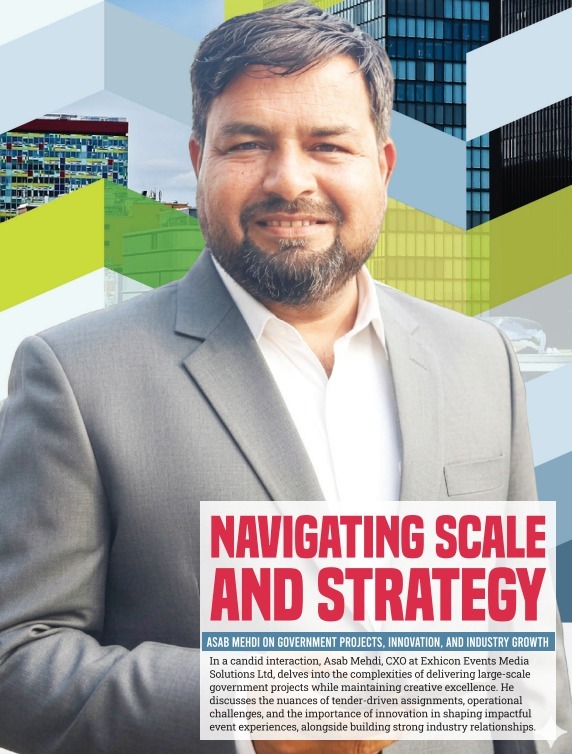
In a candid interaction, Asab Mehdi, CXO at Exhicon Events Media Solutions Ltd, delves into the complexities of delivering large-scale government projects while maintaining creative excellence. He discusses the nuances of tender-driven assignments, operational challenges, and the importance of innovation in shaping impactful event experiences, alongside building strong industry relationships.

Building strong, long-term relationships with government bodies isn’t about networking alone, it’s about consistent credibility, reliability, and value delivery over time. In the exhibitions and events space, relationships are earned project by project.
TFT: As Chief Experience Officer, how do you define “experience” in the context of exhibitions and live events today?
AM: As Chief Experience Officer, I define “experience” in exhibitions and live events as the total emotional, sensory, and meaningful journey a participant goes through—before, during, and after the event.
Today, experience is no longer limited to what people see on the show floor. It’s about how they feel, how they engage, and what they take back with them.
In a modern context, experience has certain key dimensions:
- Personalization
Every attendee expects relevance. From curated agendas to targeted interactions, the experience should feel tailored, not generic.
- Engagement & Interaction
Experience is participative. Whether through live demos, networking formats, or digital integrations, attendees should be co-creators, not spectators.
- Seamless Journey
From registration to exit—and even post-event follow-ups—the journey must be frictionless, intuitive, and well-orchestrated across physical and digital touchpoints.
- Measurable Impact
A great experience drives outcomes: brand recall, business connections, knowledge transfer, and emotional resonance. If it’s not remembered or actionable, it’s incomplete.
TFT: What are the key factors that determine success in securing large-scale government tenders in the exhibitions and events space?
AM: So the Government works mostly on L1 (Lowest Bidder) or QCBS (Quality + Cost Based Selection) on both Tender platforms Gem Portal & E-Procurement. Any Organisation participating in Tender have to take care for basic 8 Pointers.
- Strong Technical Proposal
- Relevant Experience & Past Projects
- Financial Strength & Stability including BG, EMDs, Strong balace sheet & financial Background.
- Compliance & Documentation
- Competitive Pricing Strategy
- Not just lowest price (L1), but value-based pricing
- Smart cost optimization without compromising quality
- Understanding of BOQ (Bill of Quantities)
- Vendor & Supply Chain Network including Backup Vendor & Crisis Management
- Project Management Capability & Relationship Management
- Innovation & Technology Integration
- Use of digital displays, AR/VR, smart kiosks
- Efficient crowd control systems
- Sustainable materials and green practices
TFT: What are the biggest operational or execution challenges you face while delivering government-led projects, and how do you overcome them?
AM: Delivering government-led events isn’t just about good planning, it’s about managing complexity under pressure. The biggest challenges usually come from scale, compliance, and coordination. Here are some practical breakdown what team face on ground and how to handle them
- Tight & Non-Negotiable Timelines (One have to be prepare Backup Vendor & manpower pool, also shift planning is very important to meet timelines)
- Complex Approval & Compliance Processes (Assign a dedicated compliance manager, Build relationship with authorities for fastest approvals of creatives & other elements)
- Multiple Stakeholder Coordination (Prepare Centralized communication System & assign SPOC for each stake holder)
- Payment Delays & Cash Flow Pressure (Clear Contract Terms at initial stage, strong financial planning and Milestone billing instead of Final billing on completion)
TFT: Government projects often come with strict compliance and timelines. How do you balance creativity and innovation within these structured frameworks?
AM: Balancing creativity with strict government compliance isn’t about choosing one over the other, it’s about designing creativity to fit inside the framework.
- Start with Compliance-First Creativity, Make all compliance Requirements & then start creative concept accordingly)
- Innovate in Layers (Not Core Structure) & Add creativity through lighting, content, digital screens, graphics, storytelling, Add AR/VR.
- Pre-Approve Creative Elements for last minutes rejection, Get Stakeholder Buy-in before execution.
- Use Proven Innovation (Not Risky Experiments) & no Experiments, Use Global approved practices.
- Align Creativity with Government Objectives of the Event is very important, Awareness campaign, Trade Fairs, Public events all should be treat as per their expected outcomes.
TFT: How do you approach relationship-building and long-term engagement with government bodies and public institutions?
AM: Building strong, long-term relationships with government bodies isn’t about networking alone, it’s about consistent credibility, reliability, and value delivery over time. In the exhibitions and events space, relationships are earned project by project.
- Deliver Reliability First, Then Expand Scope, Government bodies Rely on past performance & Your response time
- Maintain Transparency & Clean Processes
- Build Multi-Level Relationships
- Position yourself as a partner, not just a vendor, Think about Long terms not Transactional
- Relationships grow in the “off-season,” not just during bidding,
TFT: With increasing focus on Digital India, smart cities, and infrastructure development, what new opportunities do you see emerging in government-led exhibitions?
AM: With initiatives like Digital India, Smart Cities Mission government-led exhibitions are evolving from static showcases into high-impact, tech-driven experience platforms. This shift is opening several new opportunities, The future of government exhibitions lies in blending physical scale with digital intelligence, storytelling, and measurable impact.
- Create experience-driven pavilions that simplify complex government initiatives for the public.
- Curate live demo zones and simulation environments for urban tech
- Offer end-to-end digital event ecosystems, not just physical setup
- Position yourself as a green event solutions provider
- Provide insight-based reporting and dashboards post-event