


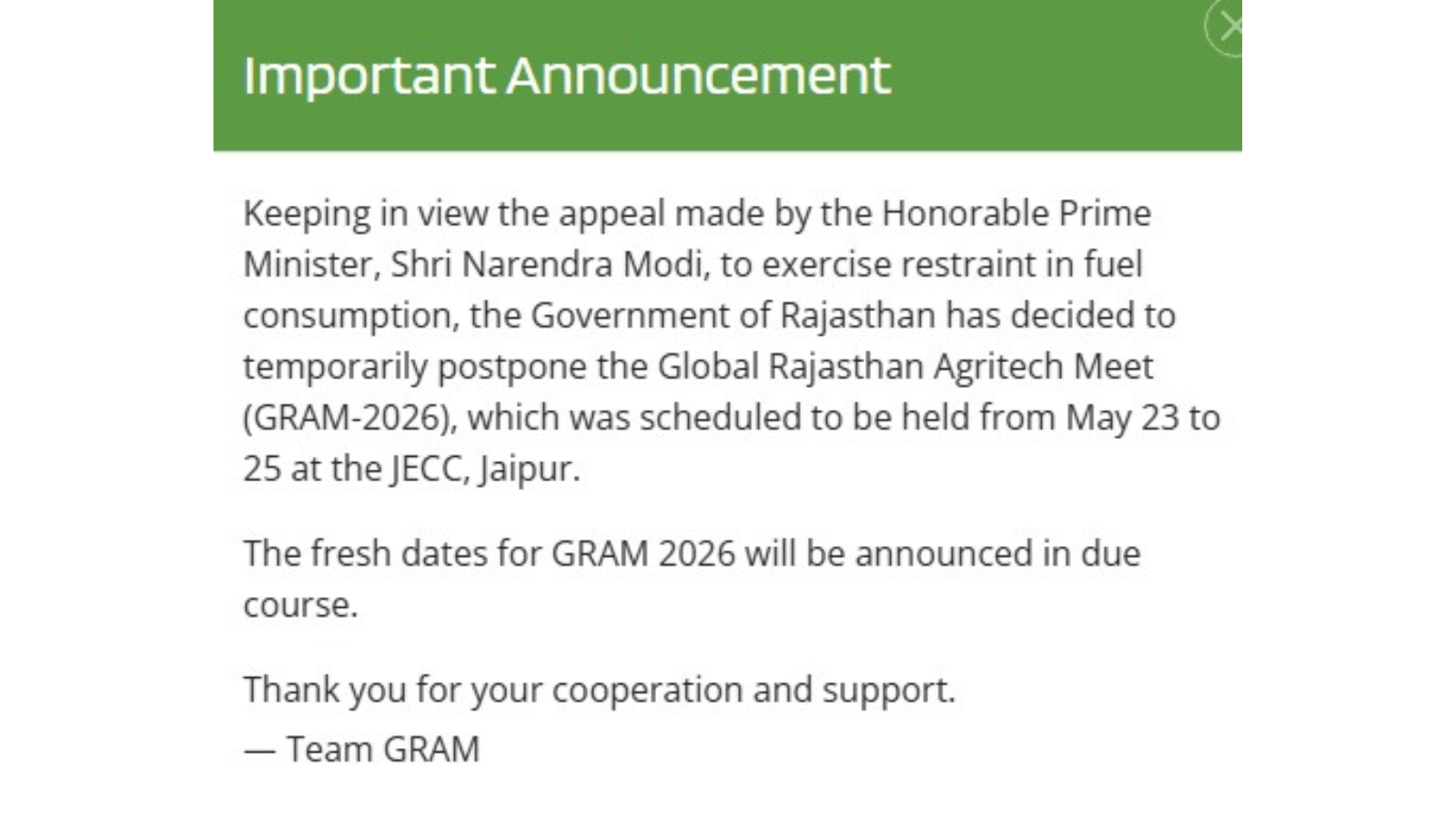
The postponement of GRAM 2026, the Global Rajasthan Agritech Meet scheduled from 23–25 May 2026 at the JECC Jaipur, has triggered serious discussions across India’s exhibition, convention, agritech, and MICE ecosystem regarding the wider economic implications of large-format event disruptions.
According to official statements, the event has been postponed “until further notice,” citing the Prime Minister’s appeal for restraint in fuel consumption and broader austerity measures being considered by the Rajasthan Government.
Immediate Impact on the Exhibition Industry
The postponement of such a mega exhibition extends far beyond the organiser or venue. Large-format exhibitions function as integrated economic ecosystems involving multiple industries and service providers.
Key Stakeholders Affected
• Organisers
• Venue
• Temporary structure and fabrication companies
• Logistics and freight operators
• Hotels and hospitality providers
• Airlines and transport services
• Event technology and registration companies
• Branding and printing vendors
• Food & beverage contractors
• Skilled and temporary manpower suppliers
For many of the vendors, project mobilisation for GRAM 2026 was already nearing completion. India’s exhibition services industry operates on highly cyclical execution timelines, where delayed events directly affect working capital rotations for multiple SMEs dependent on event execution.
Impact on the Exhibition Economy
The Indian exhibition industry has evolved into a major economic multiplier over the past decade, driven by convention infrastructure growth, manufacturing expansion, government investment summits, sectoral trade exhibitions, experiential economy growth, International business participation, Trade fairs are no more only an activity ; they are economic activation platforms.
Economic Ripple Effect
Such large exhibition generates spending across ,local tourism, transportation, retail, food services, advertising, logistics, event infrastructure.
Jaipur’s MICE ecosystem was expected to significantly benefit from visitor inflows linked to GRAM 2026. Hotels, transport operators, local tourism businesses, restaurants, and ancillary service providers would all have anticipated increased commercial activity during the event period. The postponement has temporarily suspended this multiplier effect.
Pressure on Exhibition Infrastructure Providers
India’s rapidly growing exhibition infrastructure ecosystem – including convention centres, temporary structure providers, fabrication companies, AV suppliers, and experiential agencies depends heavily on event continuity and calendar predictability. Companies involved in large-span temporary structures and pre-fabricated exhibition halls are particularly exposed due to high upfront mobilisation costs.
Is This a Structural Risk for India’s Exhibition Sector?
India continues to remain one of the fastest-growing exhibition and convention markets globally, however, concerns are emerging as multiple large exhibitions face postponements, fuel or travel restrictions expand, austerity measures continue, global geopolitical uncertainties intensify. Such trends may impact: venue utilisation, exhibitor confidence, infrastructure investments and event profitability.
Industry Associations Need to Play a More Active Role
The current situation also raises a broader industry question regarding the role of exhibition, convention and event industry associations in protecting the interests of the ecosystem during such disruptions. Industry bodies such as Indian Exhibition Industry Association, Indian Exhibitions, Conferences and Events Services Association, Event and Entertainment Management Association and India Convention Promotion Bureau may need to collectively engage with government authorities and event organisers whenever large-scale postponements occur.
Since the immediate financial and operational impact is often borne by service providers, vendors and SMEs across the value chain, industry associations can potentially act as representative bodies to initiate structured dialogue with organisers and policymakers. Such engagement could focus on improving communication timelines, establishing contingency frameworks, protecting stakeholder interests and ensuring better visibility around event scheduling decisions.
As India’s MICE and exhibition ecosystem matures, a collaborative approach between government bodies, organisers and industry associations may become increasingly important to preserve business confidence and reduce disruption across the wider event economy.